Sunday, January 13, 2013

Scouring the Nation (Part 14) Retrospective

In this edition of "Scouring the Nation (Part 14) Retrospective", I take a look back at some of the talented players from last year that I was not able to review due to time constraints. Some may be pursuing basketball careers overseas or hoping to land a minor league role in the United States. In this edition, I examine some of the top NAIA talent (Division I) and players from Division III. 

The first prospect that I will focus on in this segment is NAIA Division I Player of the Year Cameron Gliddon. This 6'5 Concordia (CA) guard was one of the more versatile players outside of Division 1 a year ago, and he led his team to an NAIA Division I National Championship. First and foremost, though, Gliddon thrives as a shooter and demonstrates considerable promise coming off of screens. 77.3% of his field goal attempts were from beyond the arc. In the contests that I witnessed, Gliddon received the vast majority of his points by properly rubbing off of screens to free himself for easy looks. Gliddon possesses nice mechanics on his shooting stroke and was able to connect on 41.5% of his three point attempts. While he typically shoots the ball off of curls, Gliddon also is capable pulling up off the dribble. For the most part, Concordia's offense flowed through his perimeter shooting ability, and he was savvy enough to use this strength to get to the basket and find open teammates at times.  Like many of the talented Australians that came through Division I basketball (St/ Mary's Matthew Dellavedova and many others), Gliddon is a fundamentally sound player with a high basketball IQ. He knows when to shoot the ball and plays within his team's offensive sets. For Concordia, that entailed looking for his shot off of screens and even attacking the basket occasionally. Even though he is very strong protecting the ball, Gliddon does not possess an elite handle and will likely not be able to create his own shot at the next level. Despite this, he was able to find open teammates off the dribble, averaging 2.26 assists per contest and posting a 1.87 to 1 Assist to Turnover Ratio. Additionally, Gliddon is fundamentally sound with his post entry passing. And, while he did not typically attack the paint very often last season, he was able to draw fouls when he did. He is physical when attacking the basket and is not afraid to bang inside for rebounds. He averaged 3.6 boards per contest and was particularly effective on the defensive glass. On the defensive end, Gliddon is not exceptionally quick from a lateral standpoint. However, when playing with Concordia, he understood his team's defensive sets and was rather intelligent with his rotations. Gliddon also is rather savvy playing the passing lanes and picking people's pockets. He averaged just under 2.0 steals per game and was very active creating extra opportunities for his team. Overall, Gliddon is a player with a clear role at a higher level of play. If he can continue to improve his handle and lock down on defense, he should have a long career overseas.

While Gliddon has tremendous potential at the next level, his teammate Edward Willis may only be able to play in the minor leagues due to his size at the forward position. Willis is a 6'4 power forward (ala former Indiana player AJ Moye) who plays with a tremendous amount of aggression on both ends of the floor. He is athletic and plays strong on the interior, leveraging his strong base to draw fouls and obtain deep post position. Despite being undersized, Willis has decent length and is able to shoot over opponents at times due to his high release point. He uses these physical tools to face up in the post and attack at the rim. Willis does a nice job of sealing his man on the block. He is then able to out-quick bigger players to the bucket, using either hand and finishing. Willis has a very good first step, but is not dynamic enough with his ball skills to convert to another position. His handle needs to be refined and is only serviceable from the free throw line in. He also needs to cut down on his turnovers, as he averaged a near 0.5 to 1 Assist to Turnover Ratio, which is very bad if he hopes to play beyond NAIA basketball. While these turnovers are mostly due to his average interior passing and loose handle, Willis is generally a good decision maker who understands spacing and moves well without the ball in his hands. He constantly is open on cuts to the basket and he works hard to free himself under the hoop. He also makes fundamentally sound post entry feeds when temporarily stationed on the perimeter. And while he is not an exceptional shooter, his free throw shooting form shows some promise, and he may be able to extend his range for consistent mid range jumpers. (maybe even learning to connect from beyond the arc as well) Still, he was able to draw 5.89 free throws per contest due to his exceptional leaping ability and propensity for attacking the body of shot blockers. Aside from his face up game in the post, Willis also possesses a nice turnaround jumper, which he implements effectively against bigger competition. In terms of his toughness on the glass, Edward Willis is incredibly active on the boards. He possesses good box out fundamentals and is very physical when pinning his man with his lower body. Willis' length and run-jump athleticism also factor in here. He ended up averaging 5.1 rebounds per game, but this number significantly understates his impact boxing out on the glass, as he was able to ward off his opponents and often opened up opportunities for his teammates. On the defensive end, Willis possesses excellent lateral quickness for his size, and may be able to develop into a perimeter defender with a post game on offense. He moves his feet well, and has nice awareness on this end, trapping the ball at times and being at the right place at the right time. He hedges very well, and does a nice job recovering to his man. Willis is also productive on this end of the floor, collecting 1.5 steals per game. He does a nice job stripping the ball without fouling and is disruptive in the passing lanes, fronting the post when necessary. He also works hard to obtain positioning on the block. Overall, Edward Willis is one of the more unique players that I have come across who may be able to function at a higher level of play due to his versatility on the defensive end.

Aside from Willis and Gliddon, 6'2 combo guard Austin Simon had a major impact for Concordia's squad last season, contributing in a plethora of ways. Simon is a do-it-all player who is versatile enough to convert to the point guard slot if he is willing to improve his handle. Of all his various strengths, Simon does his best work attacking the basket and getting to the line. Simon is fairly strong with the ball and attacks with reckless abandon once he sees an opening. He draws contact well and is able to finish in spite of his rather ordinary strength/weight. (175 lbs.) Simon is very athletic when he gets in the lane and this enables him to draw fouls at a pretty high rate relative to how often he has the ball in his hands. He averaged 4.76 free throws per game last season and his statistics actually understate his impact in this regard. Aside from finishing strong at the rim, Simon is also a capable passer, which leads me to believe that he can play point guard down the road. He averaged 3.05 assists per contest and was generally a good decision maker with the ball in his hands, unselfishly opting to feed the post and swing the ball around the perimeter at times. And, if he is cut off in the lane, Simon has a decent pull up jump shot in his arsenal. While he was streaky at times last season, Simon did do some damage from beyond the arc as well. He shot 35.5% from distance and chose his spots fairly well. Aside from his offensive impact, Simon is a very good rebounder for his size. A year ago, he averaged 4.7 boards per game and made his mark on both the offensive and defensive glass. On the defensive end, Simon has great hands and is able to strip the ball away from the opposition. He is extremely active with his hands, and tends to get in foul trouble when he is overaggressive. In terms of his production on this end, Simon averaged 1.55 steals per game. If he can cut down on his tendency to foul, Simon has the lateral quickness to become a rather good defender. All in all, Austin Simon is a noteworthy player who may be able to play at a higher level in the Americas.

Last and certainly not least, 6'10 258 lb. forward Tommy Granado was a huge reason why Concordia (CA) was able to earn a National Championship title last season. While Granado is somewhat 'vertically challenged', he made his mark on both ends of the floor at the NAIA level. Granado is a fundamentally sound post player who utilizes his body well to create space and score inside. He scores most of his baskets from three feet in, but does have good form on his shot and may be able to extend his range in time. Granado does a nice job of carving out space on the block and physically overwhelming his opposition. He is skilled enough to score when physically challenged with a decent jump hook, but he typically is able to out-muscle post players for layups. As a result of his tenacity in the paint, Granado shot a staggering 64.8% from the floor and connected on a respectable 76% of his free throw opportunities. While he did not get to the line as often as one might expect, he did not always receive the ball from his teammates in the flow of the offense. He was often able to create extra possessions on the offensive glass (he was his team's best offensive rebounder) and finished plays through tip ins and tip outs to open shooters. In terms of his utility in offensive sets, Granado functions well as a screener at the top of the key and might eventually become a good pick and roll option. He is also a good post entry passer and is willing to give the ball up to open teammates if they have better looks at the bucket. In terms of his prowess on the glass, Granado does a nice job of securing boards by boxing out and using his superior strength to physically overpower his opponents. He averaged 6.7 rebounds per contest, and should improve on this number if he eventually cuts weight and is able to get to loose balls quicker. On the defensive end, Granado needs to shed some weight in order to become more mobile. He fought hard a season ago and was able to even play defense on the perimeter at times. However, because he is vertically challenged, he does not block shots at a high rate and is more of a positional defender. Still, he struggles to obtain good positioning on defense because of his lack of lateral quickness. If he can shed some weight and improve his quickness on the defensive end, Granado may be able to make an impact in the Americas.

Corey Chandler is a former top 100 recruit who landed at Rutgers, before eventually turning up at William Paterson for his junior season of play. At Rutgers, Chandler was a slashing combo guard who did a nice job getting in the lane and finishing at the rim. The 6'2 guard's game changed considerably in the interim, as he is now a full-time scoring point guard who creates for his teammates. In the contests I watched, Chandler was able to beat his man off the dribble with a decent handle and a solid first step. He is physically strong attacking the basket, demonstrating good body control and a decent finishing ability. When he does decide to drive, he does an excellent job initiating contact and getting to the free throw line. He averaged 5.71 free throws per contest, and connected on a decent 75.0% of his attempts last season. Chandler was able to score on most of his scoring drives and he finished well at the rim. When he decided to get his teammates involved in the games I witnessed, Chandler displayed good vision and was able to kick the ball out to open shooters once he got deep in the lane. He averaged 4.21 assists per contest and was instrumental in orchestrating the William Paterson offensive sets. But, because he had the ball in his hands so often, Chandler turned the ball over at an alarmingly high rate, averaging 4.43 turnovers per game. This must be corrected if he hopes to play at a higher level of professional play. Despite this weakness, Chandler is a capable shooter who is best shooting off the bounce. He uses the threat of his mid range shot to open up driving opportunities and is fairly crafty with the ball. Still, he was very inconsistent from beyond the arc a season ago, shooting a paltry 28.6%. Chandler must improve on this aspect of his game if he hopes to keep defenses honest at a higher level of play. Further, Chandler is physical on the glass and collected 5.9 boards per contest last season. On the defensive end, Chandler possesses good lateral quickness and was very productive a season ago. He averaged just under 1 block per game, and 2.64 steals per contest. Chandler demonstrated above average athleticism on the defensive end and was very active with his hands. Despite this, he fouled under three times per game and was an essential part of WPU defensive schemes, often directing his man towards his team's shot blockers. All in all, Chandler is a player with a lot of untapped talent who must play under control if he hopes to obtain a role at a higher level of play. He is active defensively and has the quickness to play in the pros.

Division III Third-Team All American Aris Wurtz is a 6'5 combo forward who likes to mix it up on the inside and on the perimeter. He averaged a remarkable 25.0 points per game last year. The Ripon College standout is not super quick off the dribble and does not possess a reliable enough handle to attack off the dribble professionally. However, Wurtz excels with his in between game. He likes to post up against bigger players on the block. From there, he exploits his quickness advantage to draw fouls and attack the basket. Wurtz possesses decent footwork for a combo forward and is able to out-quick bigger players inside. He does a nice job of obtaining positioning on the block.  He carves out space nicely, and attacks with a fairly reliable go-to move and counter. While this element of his game will not be as pronounced at the next level due to significantly better help defense, Wurtz does a nice job facing up and draining jump shots in the paint. In particular, he does a good job going to his reliable fadeaway jumper. Wurtz has good body control and uses his physical strength to obtain separation. When he does attack the rim, Wurtz does a nice job of drawing contact, as he averaged 6.27 free throw attempts per contest last year. He typically made the most of these opportunities, demonstrating solid form and connecting on 83.3% of his attempts. He can finish through contact, and was able to draw 'And 1' opportunities in the games I witnessed. In terms of his strength inside, Wurtz possesses decent box out fundamentals and is able to secure rebounds at a fairly high rate, particularly on the defensive end. Despite being undersized, Wurtz is physical and has a good knack for locating the ball, as evinced by his 6.4 rebounds per game. While Wurtz was a good combo forward at the Division III level, his potential mostly rests in his versatility. Wurtz is a capable three point shooter, and is able to keep defenses honest from the perimeter. In the contests that I watched, he was able to post up, and then move to the perimeter when his teammates were unable to find him. This regularly resulted in open three point looks. Wurtz possesses decent lift and solid mechanics on his jumper. Last year, he connected on 43.0% of his three point looks on 107 field goal attempts from that distance. Wurtz moves well without the ball and shows some promise coming off of screens. As a result, he may be able to play exclusively on the perimeter at the next level if he learns to tighten his handle. Because this is not an area of strength, Wurtz is not particularly effective getting his shot off the dribble. He does not often create shots for others, but is unselfish and knows when to swing the ball around the perimeter. On the defensive end, Wurtz has a lot of work to do. He was regularly matched up with taller post players, and he often either fouled them or gave up post position, frequently allowing jump hooks in the lane. When he defended out on the perimeter, he did a nice job against Division III competition, but it seems as though he does not possess the lateral quickness to defend at a much higher level of play. If Wurtz can continue to refine this aspect of his game and continue to improve physically, he may be able to carve out a niche overseas as a catch and shoot player.   

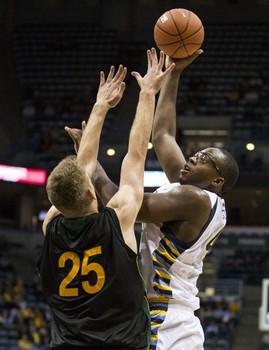
Division III standout Shane Manor deserves some mention for his performances at Wisconsin River Falls in the WIAC. While he has a rather narrow frame, Manor has very good length and height at 6'5. This lefty has a serviceable enough handle to get in the teeth of the defense and cause some damage. And, while he was not always effective scoring the basketball, he was able to contribute in other ways in the contests I saw. Ultimately, his leadership and productivity on the court culminated in a WIAC tournament championship victory over Division III POY Chris Davis' squad. After struggling to find his shot for most of the game, Manor was assertive late and scored to put the game out of reach. In terms of his tendencies, Manor primarily scores from the mid range, rarely attempting shots from behind the arc. He has a nice form and is able to get good lift on his shot. He typically scores off the bounce, and is able to pull up at any point of his drive. When attacking the rim, Manor is not terribly explosive, but his first step is effective enough to keep defenses off guard. When he does pull up for his shot, Manor is fairly efficient from the field and is a good rhythm shooter. Manor is also able to slash to the rim and demonstrates nice poise in selectively choosing when to attack, as he rarely is called for an offensive foul. When he does get to the basket, he does a nice job of drawing fouls. This is evinced by the fact that he got to the line 5.28 times per game in 2011-2012. And he demonstrated solid form on his free throw stroke, hitting 77.7% of his attempts. Offensively, Manor has a very good basketball IQ, and knows when to shoot and pass the ball. As a result, he connected on a staggering 55.6% of his shots last season. When he is not looking to score the ball, Manor does an excellent job finding teammates. The lefty is capable of making post entry feeds on the move and has the vision to thread the needle through multiple defenders. He has a fundamental understanding of how to make post entry feeds as well. When Manor was isolated in the contests I witnessed, he did a nice job of slashing and kicking the ball out to the wing for an open three point shot. He is most adept at making the wrap around pass to teammates for easy finishes. Defensively, Manor is very much a mixed bag, and most of his productivity on this end will probably not translate to the next level. He plays with decent assertiveness on defense, but is prone to mental lapses, often failing to close out on perimeter shooters or not fighting hard enough around picks. He has decent lateral quickness for the DIII level, but this will probably not translate in the pros. I project him to be slightly below average defensively, depending on what league he ends up playing in. With this said, Manor is fairly productive and has decent anticipation in the passing lanes, as he averaged just over a steal per game last season. He has good vertical athleticism and is also able to play effective help defense at times. Overall, Manor is a great player at the DIII level, who might be able to adapt to a lower division overseas or in the Americas due to his savvy basketball IQ and efficient offensive play.

Manor's teammates are notable for their performances as well, although they have more holes in their games and would likely only be able to play at a lower division in the Americas. The first player worth mentioning is standout point guard Brian Kimble, who really led his team's attack against Wisconsin-Whitewater. Kimble is an athletic 6'1 point guard with the handle and savvy to feed his teammates with the game on the line. It is worth mentioning that Kimble is more of an offensive initiator and does more than the statsheet is able to capture. He consistently slashes to the hoop with good aggression and a sense of purpose. He has good vision on his attack and has a nice enough first step to keep defenses off balance. While he did turn the ball over 2.68 times per game last season, many of the mistakes were miscues by his teammates, and he was often able to recover in these situations. In fact, sometimes when he loses the ball momentarily on drives to the hoop, he is often able to recover by stealing it back. In terms of his vision, he kicks the ball to open shooters once he gets ahead of his man. Kimble also feeds the ball inside regularly, showing a decent ability to pass over defenders, with only the occasional miscue. His poise offensively clearly provided a spark for his team last season. And, he was even able to assert himself offensively in the games I watched. While he is not a shooter by any stretch, (27.3% from 3, and 43.6% overall) Kimble does make shots when they matter most, late in the game. In fact, he was able to put his team ahead with an open three point look. He does a better job shooting when he receives a screen off the dribble. He can connect off one or two dribbles as well, and is not markedly more efficient at either. Kimble does a decent job of getting to the line and draws contact when he looks for his shot. On the defensive end, Kimble projects as an impact player at a lower level of play. He led his conference in steals as season ago, and has very active hands. Kimble also has good lateral quickness and is able to stay with just about anyone. He is a physical defender and is patient enough on defense to wait for the right moment before forcing turnovers. (instead of gambling) Kimble is a decent help defender and is a vocal leader on this end of the floor. Further, he is athletic enough to challenge effectively on closeouts. Kimble is a player to keep in mind.

Aside from Kimble and Manor, 6'4 wing Aaron Anderson is a player to take note of as well. Anderson is a lengthy wing who is proficient from behind the arc. He connected on 38.3% of his attempts last season, and was better than his percentages demonstrate. Anderson has a very nice stroke, but has a bit of a slow shooting motion, which often leads to players challenging shots that would otherwise have been released without difficulty. He moves fairly well without the ball and does a good job of spacing on the floor. He connects from beyond the arc either off the catch on a drive or handling the ball out in transition, where he can pullup and bury shots with no defense back. Anderson is a capable jump shooter from inside the arc as well. Anderson only very rarely drives to the hoop, and typically settles for jumpers with a hand in his face. Anderson is fundamentally sound passing the ball as well, and was able to feed Wade Guerin in the post with a nice post entry feed. Defensively, Anderson is a work in progress, but better than expected. While he possesses good length, he is not particularly quick from a lateral standpoint. However, he plays hard on this end, and did a really nice job defending the post at times, standing his ground and forcing misses. He does gamble a little too often in transition though. Overall. Anderson is a nice hustle glue guy who chases down rebounds, tracks down loose balls, and can keep defenses honest from three point range.

While Kimble had arguably the most impressive performance against Whitewater, big man Wade Guerin was not far behind, with his yeoman's work inside. Guerin is a 6'8 bulky forward who is not overly mobile, but is not hindered by his limitations as much as one might think. While he is not particularly quick off the dribble, Guerin was able to get in the lane at times against Whitewater, and made some nice moves scoring through contact. Guerin's handle is serviceable and he can get to where he wants on the floor. Guerin is aggressive attacking the rim and can withstand a lot of physicality; in fact, he embraces it. Guerin received most of his first half offense in the Whitewater contest off of basket cuts and feeds from Kimble and to a lesser extent Manor. He does a nice job of using his body inside to create space and is more mobile on the block than most would anticipate, given his lack of explosive athleticism and quickness. Guerin is a back to the basket player at times, but can also faceup. His handle is fairly effective from the free throw line in. When he is doing a nice job scoring inside, Guerin must do a better job of anticipating and passing out of double teams. He turns it over more often than one might expect when defenses converge. Guerin's form is fairly effective, and while he does not have great lift, he can keep defenses honest at times. He is able to shoot jumpers at the top of the key, but often settles for three point baskets, which are somewhat out of his range. When he does decide to get to the rim instead of opting to shoot the jumper, Guerin "bulls" by defenders, but is crafty enough to avoid charges. On one particular play, he actually had a very impressive scoop shot in the lane after beating his man off the dribble. Guerin is good on the offensive glass for tip ins, and is fairly effective rebounding the ball overall, averaging 7.57 boards per contest. On defense, Guerin is laterally challenged, but does a decent job on post ups. He must watch his physicality at times though. With his limitations in mind, Guerin does have surprisingly good hands on defense and was able to poke the ball away on multiple occasions in the contests I watched.

These four seniors for Wisconsin River Falls really contributed a lot on both ends of the floor. They did also have junior Ollie White, who put them over the top in their matchup with Wisconsin Whitewater. White is a fairly athletic 6'7 215 lb big man who is much stronger than his physical measurements reveal. He is active on offense, tipping the ball in and finishing through contact. He does a nice job of maneuvering around players and shielding the ball with his body. White does a very good job of drawing contact, as evinced by his 4.75 free throw attempts per game last season. He has decent footwork in the post, but could use some work in that respect. White has a decent stroke, but very rarely steps out to hit three point baskets. On the defensive end, White has very good hands and is able to poke the ball away from bigger players. He may want to add to his frame if he hopes to play post defense at a higher level. He is laterally quick and is active with his hands. White averaged over a steal a game last season out of the post. All in all, White is a good athlete who may be able to develop into a role player at a lower level of play in the Americas if he continues to work on his game. It will be interesting to see if he adjusts to a lead role this season.

While River Falls had impressive players (and I've already reviewed Whitewater's MVP Chris Davis) 6'0 backup point guard, Quardell Young actually caught my attention for his ability to play with such poise in limited minutes. Young came into the game and instantly provided an offensive impact, getting to the line frequently attacking the rim. He has a good first step and is strong enough to finish through contact. Young has a pretty wide frame and may be able to add even more muscle to his frame. The freshman found teammates and even rebounded in traffic, demonstrating considerable athleticism and vision. After watching him, I expected Young to have a breakout year this year, and so far he has increased his production considerably, averaging 12.5 points per game on an efficient 54.9% shooting. (and 35.3% from three point range) He is certainly a young player to keep an eye on down the road.

Two other Division III weapons from Marietta College deserve some attention here. 6'6 200 lb wing Trevor Halter is not an exceptional athletic specimen, but was extremely serviceable in his time at Marietta College. While he played in limited minutes in 2011-2012, Halter was a high impact player the season before, shooting an impressive 45% from beyond the arc on 140 attempts. His penchant for long range shooting should help him obtain a niche role at a higher level of play, despite his limited playing time in his senior campaign. Aside from his outside shooting stroke, Halter is also capable of pulling up from the mid range, hitting 52.9% of his shots overall. He is strong going to the basket as well and drew 4.06 fouls per contest when he received significant playing time. Even though Halter is a fairly strong shooter, he surprisingly only shot 64.3% at the line in his time at Marietta College. Even though Halter is fairly physical, he was not a great rebounder relative to his size. On the defensive end, Halter uses his strength, but is not exceptionally quick from a lateral standpoint. He is not overly active with his hands either, but he still averaged over 2.4 fouls per contest. Overall, Halter is a player to keep an eye on due to his size and proficiency from behind the arc.

Teammate Kevin Knab is a 6'6 undersized post player who is aggressive inside and obtains most of his points getting to the basket. Knab is a fairly distinguished post player at the Division III level and is capable attacking defenders and drawing fouls. He averaged 6.23 fouls drawn per contest and he played very physically on the block and going for rebounds. Knab has decent back to the basket moves and can also face up. He is capable shooting the ball from inside the paint and is very efficient scoring, hitting 59.3% of his field goal attempts in 2011-2012. Knab is a fundamentally sound rebounder, who challenges much bigger opponents. He averaged 6.3 boards per contest last season. On the defensive end, Knab does a good job of being physical in the post. He is not exactly foul prone and is active with his hands at times. In general, Knab is an undersized forward who would likely be able to play minor league basketball due to his aggressive nature on both ends.

Additionally, Frostburg St.'s Troy Dockett is an offensive specialist who will be able to make an impact in the minor leagues as a shooter. Dockett was able to get mid range shots off the bounce in the contests that I witnessed, and he was fairly efficient from the field overall, shooting 47.8%. With that said, he could stand to do a better job finishing at the rim. Because he is mostly a jump shooter, he did not get to the line often last year. Despite his limitations offensively, Dockett is most promising as a specialist three point shooter. Last year, he connected on a blistering 50.0% of his 136 three point attempts. Dockett possesses good shot selection and was very valuable to his team hitting shots off the catch. On the defensive end, Dockett was productive, averaging 1.5 steals per contest. Still, he must look to become more of a lockdown defender. And, at 6'0, he gives up some size, so players will be able to shoot over the top of him. Still, he has good instincts on defense and may be able to make up for his lack of size by forcing turnovers. Finally, Dockett is not a pure point guard, and must work on integrating his teammates before he can develop into a specialist at a higher level of play. His below 1 to 1 Assist to Turnover Ratio is alarming for a player that will likely have to play point guard at the next level, even if his greatest strength rests off the ball.

Undersized Emory guard Austin Claunch also made a name for himself last season. Standing at 5'9, Claunch made a huge impact for his team in virtually every statistic. He not only was able to score the ball attacking the hoop and from beyond the arc, but also got to the line driving to the basket. He averaged just under four trips to the line per game, and this is fairly remarkable considering how unselfish Claunch is as a player. He is a capable three point shooter who hit 36.6% a season ago, but was actually more proficient from this distance when he was not responsible for such a large portion of his team's offensive output. Claunch picked his spots well on the floor and shot 46.0% from the field. Even though he was a capable scorer at Emory, Claunch made his mark with his passing ability. He did a nice job of getting in the lane and dishing to open teammates, and was effective out in transition. Claunch was one of the top passers in Division III last season, orchestrating his team's offensive sets with remarkable efficiency. He ended up averaging 7.2 assists per game, and this is a very high number at the Division III level, where it is not a given that one's teammates will finish at the rim. On defense, Claunch is below average due to his height, but he displays some good quickness on this end. Claunch may be able to run offensive sets as a backup point guard due to his unique court vision if given the opportunity.

Another guard with outstanding court vision is Rust College's William Montgomery. The 6'2 point guard had one of the best handles in Division III a year ago and was able to find his teammates on most possessions. Montgomery is the epitome of a pass first point guard. His impact of this level of play is very reminiscent of Kendall Marshall's at UNC. He has good height for a point guard and is able to push the tempo and find open teammates. Markeith Wilson was a good option for Montgomery due to his ability to stretch the floor. Montgomery constantly has his head up and is able to alley oop the ball to his big men in halfcourt sets or in transition. Also, he creates a lot of open opportunities by driving in the lane and making chest or bounce passes to cutters. In terms of his ability to pass off the bounce by getting defenses to converge, he is also reminiscent of Scott Machado. Montgomery is a capable three point shooter and can keep defenses honest, even though this is not his greatest strength. (and he can be fairly inconsistent in this area) He is a decent rebounder and is able to clean up plays on the glass despite his size. Like Machado and Marshall, Montgomery's weakness is on the defensive end. He must do a better job of keeping his stance and not giving up uncontested drives. He rarely steps in to take charges, and he definitely must improve as a positional defender. Overall, Montgomery was one of the few players outside of Division 1 who can impact the game solely by creating for his teammates. He is a good leader and floor general who should play at the minor league level.

Finally, Salem St.'s Daniel Clark is a 6'5 senior shooting guard who is capable of hitting perimeter shots. He has a nice looking stroke and range on his jump shots. Clark is also a good rebounder, who boxes out and utilizes his size to the fullest extent. Further, he is very unselfish with the ball in his hands, and was willing to come off the bench if it impacted his team for the better. He regularly looks to swing the ball from side to side, and helped Salem St. run crisp offensive sets. On defense, he does not possess great lateral quickness, but was able to rotate effectively most of the time. He has a decent understanding of helpside defense and uses angles to cut his man off on this end.


(Image Sources: cuieagles.com, nj.com, and strakejesuit.org)

Friday, December 28, 2012

Expanding Your Basketball Horizons (Part 1)


In my “Expanding Your Basketball Horizons” series, I unveil the most talented players outside the bounds of Division I basketball and assess their future prospects at a professional level of play.

In this first installment of my “Expanding Your Basketball Horizons” series, I explore talented Truett-McConnell College wing Anthony Dorsey and several other early season standouts in NAIA Division I.

Truett-McConnell College’s Anthony Dorsey is one of the top perimeter players outside of Division I. Hailing from Hillsborough Community College, Dorsey is a standout scorer with the build and physical traits to succeed at a professional level. The 6’5 wing possesses good length, a decent first step, and the physical tools to play at a high level. He is not especially strong, and would benefit greatly from professional strength training.

In terms of his impact on the court, Dorsey is one of the top pure scorers in the NAIA, averaging 26.69 points per contest.  He gets his points in a variety of ways, functioning as both a jump shooter and a slasher. Dorsey is capable of breaking his man down off the dribble, and he possesses a serviceable handle that allows him to get to different spots on the court. He utilizes a decent crossover move and is comfortable attacking the basket with either hand. Dorsey does a nice job of shielding the ball to his body. When he does get to the rim, Dorsey has the athleticism and body control to finish through contact. With this said, Dorsey must do a better shot of seeking out contact, as his four free throw attempts per game is not enough for someone with his scoring prowess.

While he is capable of driving all the way to the basket and he utilizes this threat to create separation from his defender, Dorsey predominantly functions as a jump shooter who is able to create his own shot and is comfortable scoring off the bounce. He does a nice job of squaring his body off the dribble, and his high release point on his shot enables him to score over defenders. He has a nice pull up jumper, and also is able to square his body to the basket on post up attempts, finishing fadeaway shots close to the rim. Not only is Dorsey able to score off of the bounce, but he also shows some promise shooting off of screen sets. Dorsey moves well without the ball, and is particularly effective on in bounds sets, where he got much of his offense in the contests that I watched. Overall, Dorsey is currently connecting on 54.0% of his shots from the field. 

With these strengths in mind, Dorsey must improve as a long range shooter. He is connecting on only 32.7% of his attempts from beyond the arc, many of which are forced. His shooting form is rather average with a high release point, but he must work to keep his form consistent on his three point attempts. Dorsey’s decision making also must improve for him to be considered a top non-D1 prospect. His 0.64 to 1 Assist to Turnover Ratio is very much below where one would expect. While he is one of the few players on his team that can create his own offense, he must make stronger passes, and not try to force the issue. He is fairly unselfish and when he sees open teammates, he typically looks for them, especially off of dribble penetration. Dorsey is a good rebounder for a wing, averaging 4.77 rebounds per contest. His solid length and his knack for getting the loose ball enable him to achieve successful in this area.

Even though he is one of the top offensive options in the NAIA, Dorsey may have just as much potential on the defensive end. While it is difficult to assess given the fact that he is not playing against Division I competition, Dorsey possesses good lateral quickness and athleticism. When his man beats him off the dribble, Dorsey is often able to recover and block his opponent’s shot. He is averaging 1.00 block per contest, and this is a testament to Dorsey’s timing and quick leaping ability. Dorsey also does a nice job fighting through screens, and does a very good job contesting and closing out on jump shooters without fouling. On several occasions in the contests I watched, Dorsey did not bite on shot fakes from the perimeter. Further, Dorsey has quick hands and averages 0.69 steals per contest. Based on his performances at the JUCO level, I expect this number to be higher as the season progresses. Finally, Dorsey is a strong post defender who stands his ground and is able to contest the post entry feed. He does all this averaging about 1.5 personal fouls per contest.

Overall, Anthony Dorsey is one of the top perimeter prospects due to his prowess on both ends of the floor as well as his rare physical characteristics at 6’5. If he continues to produce and make his teammates better, he may be able to receive some looks at the Portsmouth Invitational.

Another high scoring NAIA standout, Robert Martinez, is the leader of a talented Our Lady of the Lake squad. The diminutive 6’0 point guard often plays off the ball and is extremely effective scoring from long range.  In fact, most of his scoring comes from beyond the arc.  So far, he has connected on 51.0% of his 100 three point attempts on the season (out of 150 field goal attempts overall).  Martinez boasts a picture-perfect shooting stroke with good elevation and a consistent release point. Martinez is capable of shooting long range bombs off the dribble, but typically prefers to receive the ball in catch and shoot situations. He does a good job getting ahead of defenses and pulling up in transition. Martinez moves well without the ball and thus is able to set himself up for open attempts.

Aside from his long range shooting, Martinez is a good passer, who looks for his teammates when slashing to the rim. Although he does not have a very long first step, it is quick enough to get past initial defenders at this level. He does a good job shielding the ball when attacking the basket. While he only averages 2.27 assists per contest, this is largely because he does not have the ball in his hands most of the time. Martinez does most of his work creating opportunities without bringing the ball up the floor. As a result of this as well as his prowess from beyond the arc, Martinez is utilized as more of a spot up shooting weapon than a pure point guard. With that said, Martinez projects as a point guard who can keep defenses honest.

Aside from his promise on the offensive end, Martinez averages 2.27 rebounds per contest, which is very good for someone with his size.  On the defensive end, Martinez possesses good lateral quickness and does a good job contesting on long closeouts. He has quick hands and averages 1.18 steals per game. With that said, his lack of length and bulk will hurt him in defending bigger weapons at a higher level of play. All in all, Rob Martinez is a promising offensive option with the range and quickness to play professionally after his collegiate career is over.

Rob’s teammate Lo’Ron Smith is a bulky guard who is capable of scoring in a variety of different ways. Smith has a strong frame, at 6’3 195 lbs, but he could stand to cut some weight in order to improve his quickness. He is Our Lady of the Lake’s second leading scorer, averaging 18.90 points per contest. Smith scores most of his baskets off of jumpers in the paint, and dials in from 14 and 16 ft off a few dribbles. He scores many of his baskets off in bounds plays designed to free him up. Smith also has the girth to create separation and score through contact both on the perimeter and attacking the rim. While he does not get to the line often, he makes the most of his opportunities, connecting on 85% of his attempts. Smith is capable shooting from beyond the arc, and is able to keep defenses honest, hitting 43.8% of his three point attempts. Smith projects as a capable screen and roll player who can hit shots from the mid range and beyond the arc.

Smith is a high motor player that impacts the game apart from his individual scoring. He averages 3.80 rebounds per contest and is strong boxing out and securing loose rebounds. Smith is also active on the defensive end, where he blocks shots and pokes the ball away for steals. He is currently averaging 0.60 blocks per contest and 2.00 steals per game. Smith is not a great decision maker on the defensive end though. He often gets into foul trouble, particularly defending post ups, where he uses his hands to push off and edge his man out of the paint. He also does a poor job finding and creating opportunities for his teammates. He must improve on his decision making if he hopes to play at a higher level.
 
Texas College’s Wendell Maye is another talented offensive weapon in the NAIA. The 6’3 wing scores the vast majority of his points attacking the rim, either in half court sets or up ahead in transition. He regularly beats the opposition down the floor and goes strong to attack the basket. Maye is incredibly active all over the court, and tips home baskets on the offensive glass as well. He averages 4.07 boards per contest. These easy opportunities have allowed him to shoot an efficient 50.9% from the field overall. Even in halfcourt sets, Maye has a quick enough first step to get by his initial defender and draw fouls at the rim, where he connects on 78% of his attempts at the line. Maye also has the handle and strength to shield the ball away from defenders and get to the rim. And while Maye’s stroke is somewhat mechanical and he did not connect from three point range in the contests I witnessed, Maye is making 44% of his shots from beyond the arc, a very efficient clip. This is probably due to the threat of his drive and the fact that he picks his spots well from the floor.

In terms of his decision making, Maye turns the ball over more often than he creates assists for his teammates, leading to a below 1 to 1 assist to turnover ratio. Because of his strong ability to penetrate to the basket, one would expect Maye to set up his teammates more often. On the defensive end, Maye has very quick hands and does a nice job anticipating in passing lanes. He collects 2.36 steals per contest and uses this to fuel easy transition opportunities. Overall, Wendell Maye is a promising slasher with a reliable three point stroke and great anticipation ability.

Maye has several other teammates at Texas College with developing skillsets. Texas College point guard Jamal Robertson is a 5’10 point guard with a slashing mentality and a willingness to distribute to open teammates. Robertson has an excellent first step and is able to get past initial defenders. When he does, he either finishes at the rim or creates opportunities for big men Kerry Jones and Titus Stephenson. Robertson must do a better job finishing through contact (44% from the field overall) and become more efficient from beyond the arc if only marginally, where he is hitting 36.0% of his attempts. Robertson has good vision driving in the lane, and averages 3.80 assists per contest. He must cut down on his 2.90 turnovers per game if he hopes to play at a higher level. On the defensive end, Robertson is vulnerable to players shooting over the top of him. However, he has good lateral quickness and the hands to steal the ball away from his opponents. Much like Maye, he averages 2.30 steals per contest, employing his solid athleticism and anticipatory tendencies to create transition opportunities. Robertson is a solid point guard for Texas College who may be able to play at a higher level.

Texas College big man Kerry Jones is another promising player who does a nice job finishing close to the rim. Jones regularly frees himself for open opportunities and is a viable target on the block. Jones has a decent back to the basket game, and employs good footwork to maneuver around the opposition in the paint. Jones is efficient around the basket and is shooting 56.3% from the field.  He does a good job of sealing his man on the block and facing up and attacking the basket if he receives the ball outside the paint. When he gets the ball in deep, he is able to draw fouls at a fairly high rate, using his body to attack the rim. He currently has 61 free throw attempts early in the season. Jones is also effective on the glass, averaging 7.07 boards per contest. He is very capable on the offensive glass, and creates extra opportunities for his team. Jones possesses good box out fundamentals, a knack for the ball, and the strength to corral it against bigger opponents. Jones is also an adept passer, serving as an option on the in bounds play to advance the ball. On one particular occasion, he was able to throw a running one handed pass from the opposing team’s free throw line to an open teammate for a slam dunk. Defensively, Jones does an excellent job fronting the post and chesting his man out towards the top of the key. Jones plays fundamental post defense, opting to go straight up instead of gambling and fouling his opponent. Overall, Kerry Jones is a promising big man who could develop into a role player somewhere on this continent.

Fellow frontcourt player Titus Stephenson is an active combo forward with a decent in between game. While he does not have a quick enough first step to create separation from his defender, Stephenson can post up or face up and attack the rim. He is able to start as far out as the three point line, as he is a threat to score from beyond the arc, hitting 46.2% of his 13 attempts. Stephenson is active moving without the ball and tends to be the recipient of good passes cutting to the rim. Stephenson has a good enough handle to attack off the dribble, but is limited by his lack of quickness. Stephenson is aggressive and is able to get to the line pretty regularly, drawing 60 free throw attempts so far in early action and connecting on 83.3% of his attempts. On the defensive end, Stephenson predominantly plays post defense, and possesses average lateral quickness defending the perimeter. With that said, he generally does a nice job on closeouts, but must keep himself from fouling jump shooters. In a contest I watched, he fouled a three point shooter late in the game, which took his team out of the contest. Stephenson is also a good rebounder for his size who creates extra possessions for his team. He must continue to work on his decision making, and he could become a good role player if he commits the time to improve his deficiencies on the court.

 
(Picture Source: njcaa.org)
 

Tuesday, December 11, 2012

Early Season Top 70 NBA Prospects

The following is an early list of my top 70 NBA prospects. Obviously, conference play will shake up these rankings (it does every year), as some players' weaknesses will be exposed, while others will step up their games late in the season.

1.       Cody Zeller, Indiana

2.       Archie Goodwin, Kentucky

3.       Otto Porter, Georgetown

4.       Alex Len, Maryland

5.       Shabazz Muhammad, UCLA

6.       Isaiah Austin, Baylor

7.       CJ McCollum, Lehigh

8.       Nerlens Noel, Kentucky

9.       Alex Poythress, Kentucky

10.   Mason Plumlee, Duke

11.   Marcus Smart, Oklahoma St.

12.   Trey Burke, Michigan

13.   Tony Mitchell, North Texas

14.   Gorgui Dieng, Louisville

15.   Michael Carter-Williams, Syracuse

16.   B.J. Young, Arkansas

17.   Steven Adams, Pittsburgh

18.   James McAdoo, North Carolina

19.   Ben McLemore, Kansas

20.   Glenn Robinson III, Michigan

21.   Victor Oladipo, Indiana

22.   Willie Cauley, Kentucky

23.   Rasheed Sulaimon, Duke

24.   Anthony Bennett, UNLV

25.   Jackie Carmichael, Illinois St.

26.   Rodney Purvis, NC State

27.   LeBryan Nash, Oklahoma St.

28.   Jeff Withey, Kansas

29.   Phil Pressey, Missouri

30.   TJ Warren, NC State

31.   Rodney Williams, Minnesota

32.   Kaleb Tarczewski, Arizona

33.   Spencer Dinwiddie, Colorado

34.   Przemek Karnowski, Gonzaga

35.   Tim Hardaway Jr. Michigan

36.   Allen Crabbe, California

37.   Ray McCallum, Detroit

38.   Doug McDermott, Creighton

39.   CJ Leslie, NC State

40.   Jamaal Franklin, San Diego St.

41.   Russ Smith, Louisville

42.   Michael Snaer, Florida State

43.   Andre Roberson, Colorado

44.   C.J. Wilcox, Washington

45.   Richard Howell, NC State

46.   Lorenzo Brown, NC State

47.   Mike Moser, UNLV

48.   Patric Young, Florida

49.   Deshaun Thomas, Ohio State

50.   Sean Kilpatrick, Cincinnati

51.   Talib Zanna, Pittsburgh

52.   Jarnell Stokes, Tennessee

53.   Fuquan Edwin, Seton Hall

54.   Mike Muscala, Bucknell

55.   Greg Whittington, Georgetown

56.   Nate Wolters, South Dakota St.

57.   Isaiah Cannon, Murray St.

58.   Erick Green, Virginia Tech

59.   Chane Behanan, Louisville

60.   Geron Johnson, Memphis

61.   Brandon Paul, Illinois

62.   Elijah Johnson, Kansas

63.   Ryan Kelly, Duke

64.   Adonis Thomas, Memphis

65.   Nik Stauskas, Michigan

66.   Elias Harris, Gonzaga

67.   Trevor Mbakwe, Minnesota

68.   Karron Johnson, Shaw University

69.   AJ Matthews, Farmingdale St.

70.   Keith Appling, Michigan St.
NR- Myck Kabongo, Texas


(Image Sources: collegebasketballtalk.nbcsports.com, zimbio.com, espn.go.com, buffzone.com, Seattletimes.com, Aol.sportingnews.com, Newsherald.com, Bigstory AP.com)

Sunday, November 18, 2012

2012-2013 Breakout Players (Midmajor Edition)

In this edition of the 2012-2013 Breakout Players segment, I explore midmajor talents poised for breakout seasons.


Ray McCallum, Detroit- While he had an excellent season a year ago, McCallum has made some significant strides this offseason, as evinced by his play at Adidas Nations. McCallum thrives as a slasher and got to the line quite frequently last season, drawing 4.8 fouls per 40 minutes. He also does a nice job finishing in transition, and is successful playing alongside one of the nation's "high flyers" in Doug Anderson. As the coach's son, McCallum typically makes the right pass, and is a good decision maker running the show. However, while he does possess good end-to-end speed, McCallum was not particularly effective creating shot opportunities for his teammates last season. This was due in large part to his inability to keep defenses honest with his perimeter shooting. He shot a paltry 24.0% from beyond the arc, and this allowed defenses to slack on him in halfcourt sets. After his performance at the Adidas Nations camp, I expect his outside shooting to be much improved this year and for him to really exploit defenses off the dribble as a result.


James Ennis, Long Beach St.- Ennis is a lengthy, athletic 6'7 wing who is physical slashing towards the rim. Playing alongside Long Beach St. stars Larry Anderson and Casper Ware, Ennis fit in remarkably well and was very efficient from the field. He finished with the 10th best Offensive Rating in the Big West and posted a 58.9% eFG%. (79th best in the nation) Ennis was also a capable rebounder and passer last year, and really helped set up his teammates at times. With the losses of Anderson and Ware, Ennis becomes the clear cut number one option on offense. I expect him to thrive in this role and involve his teammates. On the defensive end, Ennis will likely make his biggest mark, as he did a year ago. He does a nice job contesting shots and stealing the basketball with his great length. I expect this trend to continue and for him to establish himself as one of the best wing help defenders.


Tyler Brown, Illinois St.- Brown is a 6'4 sharpshooter who will likely step into a bigger role this season after Moore's transfer. Not only can Brown fill it up from the outside, (45.4% from 3 last season) but he is also a capable passer, finishing 22nd in the Missouri Valley Conference in Assist Rate. (% of Assists to teammates' field goals made while on the floor) I expect that he will take on some of Moore's point guard responsibilities running the team, as well as scoring the basketball. He will likely attack the rim more often this season, and I feel that he has the quickness and offensive repertoire to be effective off the dribble. On the defensive end, Brown has good hands, but is not a great defender due to his average size and anticipation. He rarely fouls though, and is able to stay on the floor. All in all, I feel that Brown will become more of a national name this season alongside Jackie Carmichael and that Illinois St. will contend for a Missouri Valley Conference title.


Deshawn Stephens, San Diego St.- After not playing high school basketball, Deshawn Stephens continues to improve year after year. I expect that he will become an elite role player this season and will receive looks professionally because he is such a late bloomer. Stephens is one of the most promising rebounders in his conference, particularly on the offensive glass, where he finished 3rd in the Mountain West last season. (in terms of Offensive Rebounding %) He employs outstanding strength, anticipation and length to secure rebounds and create extra possessions for his team. I feel that his ability to grab offensive rebounds will lead to more scoring opportunities for him this season. Last year, he was very efficient from the floor, despite not being an offensive focal point- he shot an outstanding 60.8% eFG% last year. In terms of his scoring ability, I expect that Stephens will continue to make adjustments to his shooting form, which is still very much a work in progress. This will come in time. On the defensive end, Stephens is aggressive chesting players outside the paint. However, he tends to have momentary lapses where he does not box out and allows tip ins after not securing the defensive glass. Overall, I expect that Stephens will continue to make incremental improvements and should enjoy some success after he learns to employ his outstanding physical gifts.


Derrick Henry, Winthrop- Two years ago, Henry was one of the top 10 players in the state of Georgia. After receiving limited playing time in his first season at Winthrop, Henry returns in better physical shape and with a sense of purpose. The 6'3 200 lb. guard is a slasher who does a nice job of getting in the lane and drawing contact. He is physical when attacking the hoop and is creative off his dribble. Henry compliments his slashing game with a nice perimeter shooting stroke. As a point of reference, he shot 41.7% from three point range on limited attempts last season. If he can learn to involve his teammates, Henry may be a player to watch down the road. In terms of his defensive ability, Henry has decent lateral quickness and rarely fouls unnecessarily. Overall, Derrick Henry is a young player to keep an eye on in the Big South.


Marcus Davis, Houston Baptist- Davis is a 6'5 wing with good size and athletic ability. While he was one of Houston Baptist's top offensive weapons a year ago, Davis did not consistently serve as his team's go-to weapon last season. He came off the bench at times, and did not always receive consistent playing time. However, Davis is a capable slasher with good athletic ability, which allows him to finish through contact in the paint. His first step is not especially stifling, but he can cover ground in a hurry, particularly in transition. Further, he is aggressive on the glass, and finished 5th in the Great West Conference in Defensive Rebounding %. Davis is also a capable long range shooter, who connected on 40.5% of his three point attempts last year. In terms of where he can improve, Davis must finish easy buckets at the rim. While he shot an efficient 50.2% eFG% last year, he did miss many easy attempts going to the rim. This is captured by his pedestrian 45.3% two point field goal %. On the defensive end, Davis has good size and lateral quickness. He is also great at stepping in the passing lanes. Overall, if Marcus Davis can improve on his offensive consistency and play fundamental man to man defense (without gambling too much), he should receive some attention. He is an exceptionally athletic player for his level, and likely has more untapped potential.


Davion Berry, Weber St.- Following the departure of Damian Lillard to the NBA, Weber St. brings in talented transfer Davion Berry. The 6'4 guard comes from Cal St. Monterey Bay, where he was a Division II All American. In terms of his strengths, Berry is a solid shooter who can fill it up from the outside. He shot over 40% from three point range two years ago. Berry can pull up off the dribble, and is also a threat dishing to teammates. While he was an average decision maker two years ago, he did pass to open teammates. After practicing against Lillard last year, I expect that Berry will make better decisions in 2012-2013 as his team's leader. On the defensive end, Berry has decent hands. But, before I can evaluate just how effective he is on this end, I will have to see how he plays against Division I competition. Overall, Davion Berry is one of the best transfers in the country that no one has heard about.


Justin Crosgile, Eastern Washington- After functioning solely as a spot up shooter at St. Joes, Crosgile should be one of the more improved players in the country. Crosgile is quick off the dribble and has decent court vision, despite never being able to display this strength at St. Joes. At 5'11, this point guard is a very good spot up shooter, much better than what he showed with the Hawks. He often was forced into taking difficult three point attempts, and was playing out of position off the ball next to Carl Jones. While he must improve his overall efficiency by focusing on his shot selection, Crosgile has the ability to get hot from beyond the arc. He must learn to do a better job finishing at the rim, though, so that he can set up his teammates for easy buckets. Defensively, he does give up some height and is not especially quick laterally. I expect Crosgile to score early and often this year, and to begin transitioning to his full time role as his team's lead guard. He must look to create for teammates; in particular, Collin Chiverton is a solid option for him.


Nate Maxey, Texas A&M Corpus Christi- While Maxey is still a work in progress, this 6'11 center is taking noticeable strides forward and should make more of an impact in his second season with the Islanders. In terms of his strengths, Maxey is quickly becoming one of the best shot blockers in the nation, and he does a nice job utilizing his 7'8 wingspan. (2nd best blocks % in NCAA so far) He also uses his length to poke the ball away. While he is statistically productive on the defensive end, he does not yet have the lower body strength to hold his ground and prevent deep post positioning. He did add weight in the offseason, though, and I expect him to be stronger in the paint this year. Maxey is also fairly productive on the defensive glass, and he should be effective in this area as well. Offensively, Maxey is still very raw and relies primarily on tip ins and dunks for his points. As a result, he shot 59.7% eFG% last year. This is because he does not possess the lower body strength to post up against more physically imposing big men. In time, I expect this facet of his game to come along as well. All in all, while Maxey is still a project this year, he is an interesting player to keep an eye on.


(Image Sources: bleacherreport.com, noschnacks.com, stephenbrashear.com, and mysanantonio.com)

Wednesday, November 14, 2012

2012-2013 Breakout Players (Major Conference Edition)

The 2012-2013 college basketball season has opened with a bang. Several competitive matchups highlight the returning strength of college basketball in spite of the massive wave of defections following the 2012 NBA Draft. With much of the headline talent from a year ago opting to play professional basketball, other players need to step in and fill the void left by their peers. The following is a list of the projected breakout players for the major conferences.


James McAdoo, North Carolina- After a disappointing season by pretty much everyone's standards (43.4% eFG%, which would have placed him 45th out of 50 players in the ACC) McAdoo has a prime opportunity to assert himself on a large stage. All of North Carolina's starting front line are gone from a year ago, and McAdoo will immediately be considered the go-to option due to his talent and developing skillset. While he had some success in transition towards the end of last year, McAdoo must demonstrate an improved post game and a renewed aggression attacking the rim. A year ago, his post footwork left a lot to be desired and he did not receive many touches due to his limited playing time behind Henson and Zeller. This year, he will have to show scouts that he has the footwork and athleticism to maneuver quickly towards the rim. In addition, his back to the basket game should have been a point of emphasis for him this past offseason. McAdoo will continue to get his points in transition due to his ability to run the floor and his athleticism. But, he must produce on a consistent basis, as he moves from a complimentary bench role to the number one offensive option. On the defensive end, he must look to move his feet and use his improved strength to prevent players from obtaining deep post position. He is currently projected as a top 10 pick due to his physical profile and success at the high school level. This is his year to prove his worth and lead UNC to another tournament appearance.


Alex Len, Maryland- The departure of high volume scorer Terrell Stoglin should be a blessing in disguise for 7-foot returning big man Alex Len. He has added weight in the offseason and appears to be more physically imposing in 2012-2013. Much unlike McAdoo, Len was efficient in his first season of play, posting a 55.3% eFG%, despite not being a focal point of Maryland's attack. He was also a very good defensive rebounder during his time on the floor, posting a 20.0 Defensive Rebounding %. (which would have been top 10 in the ACC) While it is known that Len can run the floor and score utilizing his solid length and athleticism, he must assert himself in the halfcourt. He must improve his go-to post move and counter and really use his size to obtain favorable position on the floor. While it was difficult for him to hold post position due to his weaker lower body strength, he may be able to assert himself more often this year. Len also has potential as a shot blocker, and should become one of the more difficult players to guard in the ACC. In order to actualize his potential, however, he must stay on the floor. His 4.6 fouls committed per 40 minutes is not going to help his cause. He must become smarter on the defensive end so that he can impose his will offensively. All in all, I expect him to have a tremendous year and to help Maryland surprise a few people.


Sean Kilpatrick, Cincinnati- After impressing everyone at the Adidas Nations event this past summer, Kilpatrick is poised for a breakout year on a national scale. With Dion Dixon and Yancy Gates graduating a year ago, Kilpatrick will have the ball in his hands early and often. While he has made noticeable strides from a year ago, he posted the 11th Highest Offensive Rating in the Big East amongst all players (according to kenpom.com) and the 15th best eFG% and True Shooting% last season. While he shot a respectable 37.6% from behind the arc, I expect him to shoot more efficiently this season. And, it should be noted, however, that he posted these numbers despite the fact that he was involved in 20.5% of his team's possessions. I expect his usage to increase considerably with the graduation of Dixon and the continued emergence of Cashmere Wright at the point guard slot. Kilpatrick is also a much better passer and decision maker than his statistical output. He was 11th best in the Big East in terms of Turnover Rate last year, but he also makes heads up plays assisting his teammates. I expect to see more of that this season. On the defensive end, Kilpatrick is physical, but does a nice job of staying out of foul trouble, committing only 1.5 fouls per 40 minutes. (good for 29th best in the nation) Kilpatrick has the strength and tenacity to defend bigger players, and his play on this end of the floor will be the greatest consideration this season in terms of his long run NBA potential.


CJ Fair, Syracuse- Fellow Big East wing CJ Fair served as an important complimentary player for Syracuse's deep squad a year ago. He was aggressive attacking the basket and as a result, got to the line frequently relative to his field goal attempts. In his time at Syracuse, Fair has done most of his damage off of the ball, either from cleaning up offensive rebounds or by cutting hard to the rim. While his handle is decent enough to allow him to maneuver to the hoop, he is not an efficient pull up jump shooter and instead likes to go all the way to the rim. CJ Fair would have to play the Small Forward position in the NBA, and thus would be best served improving both his midrange pullup jump shot as well as his 3 point shooting ability. Last year, he connected on a paltry 25.0% of his attempts from behind the arc. Because he is taking on a bigger role in Syracuse's offense this year, he will be expected to diversify his game and look to score from the wing. I expect him to enjoy some success in this area, although he may be overplayed due to his poor outside shooting. Fair is dynamic on the offensive glass and posted the 22nd best Offensive Rebounding %, despite playing alongside Fab Melo and other big bodies. Defensively, Fair is aggressive and utilizes his length to poke the ball away, stepping in passing lanes and demonstrating good awareness.


Talib Zanna, Pittsburgh- Zanna is poised for a breakout year after making significant strides each of his last two seasons. This developing big man has the athleticism to finish inside amongst the trees and the aggression and awareness to grab rebounds against virtually any squad at this level of play. Zanna is extremely strong and has the upper and lower body to assert himself on the block, despite his lack of an extensive post repertoire. Zanna functions predominantly as a faceup player at this stage and has a developing mid range game. He can finish attacking the basket, and has the quickness to score past opposing forwards. Zanna was remarkably efficient last season, posting the 4th best Offensive Rating in the Big East. He typically scored at the rim and finished dunk attempts out in transition, but did show that he can occasionally step out and hit jumpers. I expect him to assert himself more in this regard in 2012-2013. Zanna was also difficult to contain on the glass, posting the 4th best Offensive Rebounding % and the 5th best Defensive Rebounding % in the Big East. He is strong with the ball in his hands and rarely turns it over. On the defensive end, Zanna plays solid fundamental post defense and works to chest his man out of the paint. With increased playing time, I expect him to be more of a factor blocking shots this season than he had been in the past. Overall, look for Zanna to have a breakout year and for Pittsburgh to reestablish themselves nationally as a contender.


Rodney Williams, Minnesota- After a magnificent performance in the NIT, I expect Rodney Williams to establish himself as one of the more prolific, athletic wings in college basketball this season. While he has looked timid in the past and not really asserted himself against top competition, I fully expect Rodney Williams to be as aggressive as ever this year. Williams is as explosive of a run-jump athlete as you are going to find at the college basketball level. He finishes strong around the rim and is physical getting to the basket. As a result, he scores efficiently and was the 17th best in the Big Ten in terms of Offensive Rating a year ago. He ranked 5th in the Big Ten in terms of his 59.0% eFG% due to his penchant for scoring inside. Aside from demonstrating a renewed aggression attacking the rim, Williams must also show that he is capable of keeping defenses honest both from the mid range and from beyond the arc. His perimeter shooting stroke leaves a lot to be desired, particularly his 30.9% 3 point %. But, he was able to shoot more efficiently from the mid range in the NIT and used this to supplement his rim-attack game. I expect this to continue this season, and hopefully he has improved his shooting touch enough to really move up the NBA draft boards. On the defensive end, Williams is not an elite defender, but has the physical tools to develop into one down the road. He combines great length and athleticism with solid footspeed. Last season he was able to use his tools to collect 2.0 steals and tally 1.0 blocks per game. Overall, I believe that Minnesota will surprise people this season and that Williams is a lock for the first round in next year's draft (barring a return to his old tendencies).


Chris Otule, Marquette- After sitting out with an injury last season, Otule will likely have an increased role in Marquette's offense with the departure of Jae Crowder. Otule is a 6'11 275 lb forward who has made significant strides since beginning his career at Marquette. While in the past he functioned almost exclusively as a role player inside, Otule will have an opportunity to showcase his improved post moves. Due to his size and strength inside, Otule has little trouble obtaining post position. However, he does not possess the footwork to be effective against top flight frontcourt defenders once he receives the ball. In terms of his offensive repertoire, he typically overpowers players at the college level and scores over them. Or, he does a nice job of shielding his defender, opting to score on an efficient half hook. He also does a nice job cleaning up the offensive glass, as he demonstrated with his 10.4% Offensive Rebounding % in 2010-2011. (17th best in the Big East at the time despite playing alongside Crowder) I expect that Otule will secure more defensive rebounds this season as well. On the defensive end, Otule is one of the most underrated shot blockers in the country. He finished the 2010-2011 season with the 40th best Blocks % in the nation. Aside from swatting the ball away, Otule plays strong positional defense, but must cut down on his fouls. (6.1 fouls committed per 40 minutes in 2010-2011)If he can stay in the game, Otule should be one of the more improved bigs in the country and one of the better role players.


Trent Lockett, Marquette- Lockett transferred from Arizona St. and will likely take some time to adjust to Buzz Williams' system. With that said, Lockett is one of the more prolific slashing guards and has the athleticism to thrive against top level competition. Lockett is very efficient getting to the rim, and is strong enough to finish through contact. He does a nice job of hanging in the air and has the explosive run-jump athleticism to finish over bigger players. As a result of his superior quickness off the dribble and athleticism finishing at the rim, he posted a 53.4% eFG% in 2010-2011. He also got to the line very often, resulting in 5.0 fouls drawn per 40 minutes. (11th best in the Pac-10 at the time) He also was capable hitting shots off the dribble, but must look to extend his range if he hopes to play at the next level. He shot a paltry 32.3% from beyond the arc two seasons ago, and must improve on this percentage this season. Lockett is capable shooting the basketball though, as evinced by his near 70% free throw percentage. In terms of his ability on the glass, Lockett was one of the better rebounding guards, finishing in the top 30 in both offensive and defensive rebounding %. Lockett is also an underrated passer and really orchestrated the Arizona St. offense during his time there. One concern is that Lockett must learn to play off the ball effectively, as Buzz Williams relies heavily on Junior Cadougan to distribute and run team sets. If he can learn to function without the ball in his hands, Lockett will thrive in Marquette's system. Defensively, Lockett has excellent lateral quickness and the hands to steal the ball. Overall, I expect Lockett to be one of the more surprising transfers in the country and to make an immediate impact.


Kyle Wiltjer, Kentucky- While Wiltjer took a backseat to some of the extraordinary freshmen UK used to earn a national title, he did have an efficient first season offensively. Wiltjer thrives as a shooter, and posted a 54.6% eFG% despite rarely driving to the basket. Wiltjer was prolific from behind the arc, connecting on 43.2% of his attempts and making his impact felt at crucial moments. He also was effective from the free throw line as most good shooters are, hitting 81.5% of his attempts. Wiltjer is also fairly unselfish, but was not able to really demonstrate this facet of his game playing behind more experienced weapons in the frontcourt. Despite these notable strengths, Wiltjer must do a better job rebounding the ball if he hopes to become a faceup 4 at the next level. He must assert himself on the glass with Noel gambling to block shots fairly frequently. Otherwise, UK will struggle on the defensive glass. Wiltjer is also a poor defender and must improve his footspeed so that he can stick with power forwards at the college level. This will likely always be a weakness, but he can work to minimize it by playing intelligently on this end. Wiltjer will likely start this season, and I expect his offensive output to increase considerably, as his strengths and weaknesses will be in clear view this year.


Terrell Vinson, UMass- This is my second year predicting a breakout season for Terrell Vinson, and I truly believe that this is it for him. Coupled with the addition of Chaz Williams, (who is clearly UMass's most important contributor) Vinson's return from injury was one of the main reasons for UMass's improvement last season. He shot the ball efficiently, hitting most of his shots around the rim and simplifying his game around the basket. At this level, Vinson functions as a faceup forward and generally scores by driving by his man or by cutting to the rim and receiving a pass. But, Vinson is more skilled than his role at UMass, and can step out and keep defenses honest. He needs to keep a consistent lift on his three point shot though. While he only shot 30.8% from beyond the arc a season ago, he did make some strides from previous years. He must considerably improve his efficiency in this area if he hopes to lead UMass to a tournament appearance. Further, Vinson was rather average rebounding the basketball last season. He must work to obtain better position on the glass. While injuries have limited Vinson in his stint at UMass, he must look to diversify his offensive game and continue to attack the basket. On the defensive end, Vinson usually defends the post and struggles against bigger players. While it is difficult to assess, Vinson may be able to transition to the wing due to his strength and decent lateral quickness. Overall, Vinson is an underrated player who is out of position at the 4 slot. If he can continue to extend his range and work on his handle and midrange game, Vinson will help lead UMass to a tournament birth.


Travis Taylor, Xavier- Taylor was a backup a season ago and did not contribute much in terms of his overall production. However, with the mass exodus that Xavier experienced in the offseason, Taylor may very well be a go-to guy in 2012-2013. In terms of his game, Taylor is an undersized energy post player with a quick leaping ability and the faceup game to attack the basket with reckless abandon. In his limited minutes at Xavier last year, Taylor was not noticeably efficient, posting a very poor 44.9% eFG%. This was largely due to his limited touches, but Taylor often tried to force the action when he did receive minutes. This is evinced by the fact that he shot 17.6% of his team's shots when he was on the floor, despite not being a focal point offensively. He often rushed himself in the post and this led to some very difficult shots. Taylor does do a very nice job drawing fouls, as he drew 4.7 fouls per 40 minutes last season and 5.8 fouls/40 mins a season before that at Monmouth. With increased usage, I expect him to return to his pre-Xavier days. When he gets to the line, however, he must improve on his near 60% free throw percentage. In terms of his prowess on the glass, Taylor is a good rebounder, and finished in the top 10 in the Atlantic 10 in terms of Offensive Rebounding % and in the top 20 in terms of Defensive Rebounding %. Defensively, Taylor struggled against stronger post players, but has the length and athleticism to block shots. Look for him to play an inspired senior season and for Xavier to surprise many people.


Roberto Nelson, Oregon St.- With the early departure of Jared Cunningham to the NBA, Roberto Nelson takes over as the heir apparent for the Beavers. Nelson is an athletic combo guard with an improving skillset. He is capable attacking the basket, and was able to get to the line often due to his explosive leaping ability. Nelson finished 13th in the Pac-12 with 4.7 fouls drawn per 40 minutes. He also has continued to improve as a distributor, (and finished 16th in the Pac-12 in Assist Rate) and I expect this trend to continue this year. With that said, Nelson must cut down on his turnovers. While he made a significant leap from his freshman year where he posted a 0.76 to 1 Assist to Turnover Ratio (last season 1.27 to 1), he still has a ways to go before he can be considered a reliable lead guard. Also, Nelson must look to improve his consistency shooting the ball from a season ago. He connected on 34.8% of his attempts from beyond the arc and posted a 47.0% eFG%, but these statistics fail to account for how streaky he was. Last season, Nelson would shoot the ball well from long range for about five games at a time and then would fall into shooting slumps. If he can continue to work on his consistency, he could become one of the Pac-12's top players. Defensively, Nelson has the quickness, hands, and athleticism to grab steals and even block shots. He will likely make strides on this end next season, and I expect him to finish as an All-Pac performer. (either 1st or 2nd team)


(Image Sources: SB Nation, Newsday, AP Photo via Feature.rr, masslive.com, and comptonmagic.net)